

 +7 7172 47 28 81






Trust and Investment: How the Chamber Builds Business Bridges with ASEAN Countries
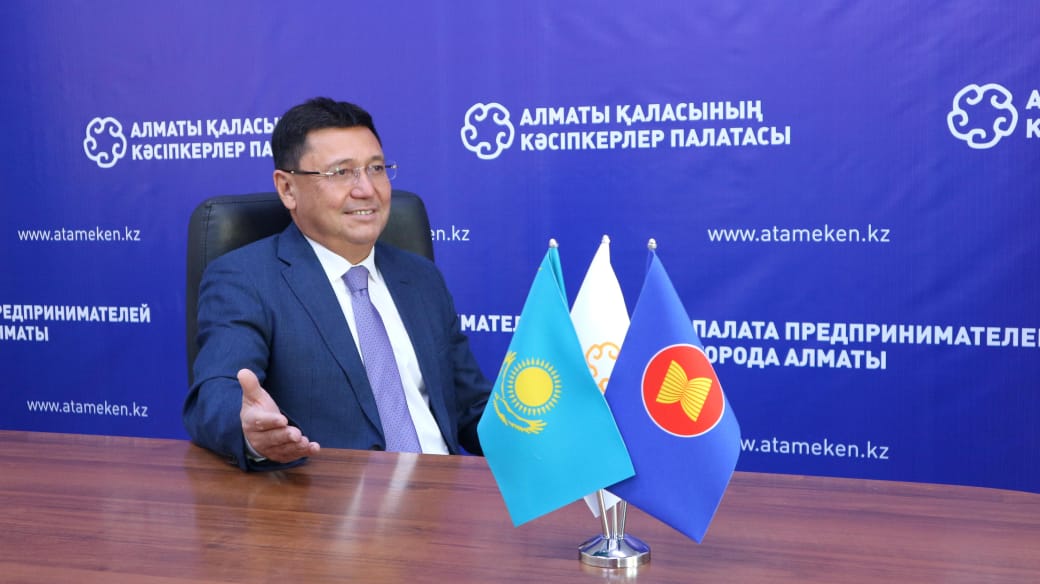
Amid intensifying global competition for investment and technology, Kazakhstan is strengthening its engagement in promising international markets. Serik Amirov speaks about the role of the Special Representative of the Chamber in ASEAN countries, the potential for cooperation with Southeast Asia, priority sectors for partnership, and the agreements already reached.
The programme for a radical overhaul of the investment attraction system, described by Kassym-Jomart Tokayev in his State of the Nation Address as a “New Investment Cycle,” was outlined by the President himself in detail. We discuss some of its key elements — including a systematic and inclusive approach to identifying foreign investors, support for smaller projects with strong market potential, and the implementation of joint initiatives in advanced sectors of the economy — with Serik Amirov, the Special Representative of the Chamber in ASEAN countries.
— Mr Amirov, you have recently taken up a newly created position within the Chamber — Special Representative in ASEAN countries. Why was there a need to establish this role?
— I believe it is a natural development under the economic policy Kazakhstan is building. In his speeches, the Head of State has repeatedly emphasised the need to create an integrated ecosystem for the effective attraction of foreign investment, as well as mechanisms to expand mutually beneficial trade and economic cooperation.
Today’s world is living under conditions of fierce competition for investment and technology. In this regard, I would like to quote Lee Kuan Yew, widely recognised as the architect of the “Singapore miracle,” who wrote in his book: “To interest foreign investors, officers of the Economic Development Board sometimes had to visit 40–50 companies before one of them sent a mission to Singapore. They worked with inexhaustible energy because they felt that Singapore’s survival depended on them.”
Such practice has not lost its relevance; on the contrary, these missions are becoming increasingly important. Direct personal communication plays a key role in building trust with business communities abroad, and such trust is indeed built gradually, step by step. This is precisely why the Chamber has introduced the position of Special Representative.
— Then it would be useful to explain what underpins our country’s interest in Southeast Asia.
— To begin with, ASEAN comprises ten countries: Brunei, Vietnam, Indonesia, Cambodia, Laos, Malaysia, Myanmar, Singapore, Thailand, and the Philippines. The bloc forms the world’s fifth-largest economy and plays a significant role in global supply chain dynamics due to its geographic location.
With a combined GDP of around US$3.8 trillion and a population of approximately 680 million, ASEAN represents a vast consumer market, which defines its substantial place in global trade.
Historically, Kazakhstan and Southeast Asia were connected by ancient trade routes — the Spice Route and the Great Silk Road. Both facilitated the exchange of goods, technologies, and ideas between peoples. Today, according to experts, ASEAN has strategic imperatives for deeper engagement with Kazakhstan. This serves as an argument for Southeast Asian companies to expand the potential of transport corridors, which in turn stimulates economic growth and development.
— What does economic cooperation between our countries look like today?
— According to official data, Kazakhstan’s trade turnover with ASEAN countries in 2024 amounted to approximately US$2.74 billion — with exports and imports roughly balanced. Total inflows of foreign direct investment into Kazakhstan from the region during the same period reached US$711.8 million. Clearly, these figures have significant potential for further growth.
— Where do you see the key points of intersection of interests?
— In addition to the characteristics of the region’s economic position already mentioned, I would add that over the past three years ASEAN has consistently attracted more than US$200 billion in foreign direct investment annually, further strengthening its status as the largest recipient among developing regions.
At present, the member states are negotiating a Framework Agreement on the Digital Economy. Thanks to the development of IT infrastructure and increased investment, ASEAN has every chance of becoming a major hub for digital companies seeking to expand.
Let us also add the following projections: by 2030, the development of artificial intelligence could contribute 10–18 percent to ASEAN countries’ GDP, amounting to up to US$1 trillion in total. The region’s experience and its forward-looking opportunities generate strong interest in the context of President Kassym-Jomart Tokayev’s objective of transforming Kazakhstan into a digital state within the next three years.
There are also strong opportunities for mutually beneficial partnership in Islamic finance, the halal industry, science and education, and tourism.
— What is the role of the Special Representative in establishing such ties?
— First and foremost, it lies in organising interaction between foreign and domestic business communities, as well as state and quasi-state structures and business circles. Perhaps the most important emphasis here should be placed on arranging and conducting personal meetings and negotiations among representatives of the entrepreneurial community. It is essential to understand the specifics of business structures in ASEAN member states, where micro, small and medium-sized enterprises account for between 97 and nearly 100 percent of all companies and play a leading role in the association’s economy.
Based on my personal experience, I can conclude that at the initial stage of building business relations, the B2G2B formula is a priority, and we are already carrying out practical work in the B2B format. In these models, the Chamber’s Special Representative typically plays a visible role. The key lies in the details, and “hands-on” work with investors — especially in the SME sector — is labour-intensive, yet extremely important.
To ensure effective B2B meetings on a systematic basis, they require thorough preparation and strong coordination with local government bodies, national companies, institutions abroad, business councils, honorary consuls, foreign trade missions, consulting firms, and other relevant stakeholders.
In addition, the Special Representative’s responsibilities include participation in events and delivering presentations abroad, assisting in organising visits of foreign business delegations, facilitating the development of trade and investment agreements, monitoring the implementation of achieved arrangements, and analysing data on the partner region.
— You mentioned that there is already experience in building links between Kazakhstani businesses and partners from ASEAN countries. Could you tell us more about this?
— Yes, of course. This is an already functioning project, and it has produced tangible results. During visits of business delegations from Malaysia, documents were signed in the areas of tourism development, IT technologies, trade, engineering, and construction. At B2B meetings between entrepreneurs from Kazakhstan and Singapore, agreements were reached on implementing a number of joint projects.
Within a networking session with representatives of the Indonesian Chamber of Commerce and Industry, we agreed to open a showroom of Kazakhstani export products in Jakarta, and investment projects in the fields of oil and gas, mining, renewable energy, and infrastructure were taken up for further elaboration.
In August, we hosted tour operators from Southeast Asia to introduce them to the tourism potential of the Almaty Region. In the near future, meetings are planned with representatives of the chambers of commerce and industry of Thailand and Vietnam, as well as business delegations from Malaysia.
Another major project worth mentioning is the intention to open a training centre for online education of domestic entrepreneurs on entering Southeast Asian markets, scaling Kazakhstani projects, placing Kazakhstani products on the region’s commodity exchanges, and developing cooperation in the field of e-commerce.
I strongly hope that building such business bridges will support domestic businesses in their aspiration to enter foreign markets and will attract new foreign business partners to our country.
 105
105